Lecture 6 Interior Point Method
Lecture 6: interior point method.
Interiorpointmethods Neos
An interior point method, was discovered by soviet mathematician i. i. dikin in 1967 and reinvented in the u. s. in the mid-1980s. in 1984, narendra karmarkar developed a method for linear programming called karmarkar's algorithm, which runs in provably polynomial time and is also very efficient in practice. it enabled solutions of linear programming problems that were beyond the capabilities of the simplex method. An interior-point algorithm gradient of objective function : c = 1 2 0 karmarkar’s algorithm using projected gradient to implement concept 1 & 2 ak dhamija • ⇒ adding the gradient to the initial leads to (3, interior karmarkar point method 4, 4) = (2, 2, 4) + (1, 2, 0) = infeasible • to remain feasible, the algorithm projects the point (3, 4, 4) down onto the feasible tetrahedron introduction complexity • the next trial solution moves in the direction of projected gradient i. e. the gradient projected onto the. Karmarkar's algorithm falls within the class of interior point methods: the current guess for the solution does not follow the boundary of the feasible set as in the simplex method, but it moves through the interior of the feasible region, improving the approximation of the optimal solution by a definite fraction with every iteration, and converging to an optimal solution with rational data. Interior pointmethods 25 years later additionally, karmarkar’s method uses a notion of a potential function (a sort of merit function) to guarantee a steady reduction of a distance to optimality at each iteration. although a single iteration of karmarkar’s method is expensive (it requires a.
Towards Interior Point Algorithm
Karmarkar’s (interior point) approach • in an interior-point method, a feasible direction at a current solution is a direction that allows it to take a. small movement while staying to be interior feasible. Interior-point method. trial solutions. cpf (corner point feasible) solutions. interior points (points inside the boundary of the feasible region) complexity. worst case: iterations can increase exponentially in the number of variables n: karmarkar’s algorithm. step 1: take an initial point 𝑥(𝑘), 𝑘=0. Karmarkar's algorithm is an algorithm introduced by narendra karmarkar in 1984 for solving linear programming problems. it was the first reasonably efficient algorithm that solves these problems in polynomial time. the ellipsoid method is also polynomial time but proved to be inefficient in practice.. denoting as the number of variables and as the number of bits of input to the algorithm. •in an interior-point method, a feasible direction at a current solution is a direction that allows it to take interior karmarkar point method a small movement while staying to be interior feasible.
Interior Point Methods 25 Years Later

π ≡ Ω∩Δ ≡𝑝𝑜𝑙𝑦��𝑜𝑝𝑒. karmarkar’s algorithm. step 1: take an initial point 𝑥(𝑘), 𝑘=0. step 2: while 𝑥(𝑘) −𝑥(𝑘−1)≤ 𝛾 𝑜𝑟 𝑐𝑇𝑥𝑘≤ 𝜀. 2. 1 transformation: 𝑇: ∆ → ∆′ such that 𝑥′(𝑘) is center of∆′. this gives us the lp problem in transformed space. Interior-pointmethod. trial solutions. cpf (corner point feasible) solutions. interior points (points inside the boundary of the feasible region) complexity. worst case: iterations can increase exponentially in the number of variables n: karmarkar’s algorithm. step 1: take an initial point 𝑥(𝑘), 𝑘=0. Method was not believed then to be either practically or theoretically in-teresting, when in fact today it is both! the method was re-born as a consequence of karmarkar’s interior-point method, and has been the sub-ject of an enormous amount of research and computation, even to this day.
In early 1980s karmarkar (1984) published a paper introducing interior point methods to solve linear-programming problems. a simple way to look at differences between simplex method and interior point method is that a simplex method moves along the edges of a polytope towards a vertex having a lower value of the cost function, whereas an. Karmarkar about this suggestion, he en dorsed it. ) the simplex and projective scaling methods differ radically. george dantzig's simplex method [1963] solves a linear pro gramming problem by examining extreme points on the boundary of the feasible re gion. the projective scaling method is an interior method; it moves through the in. Key words: linear programming, karmarkar's algorithm, interior point methods. i. introduction we describe in this paper a family of interior point power series affine scaling algorithms based on the linear programming algorithm presented by karmarkar (1984). Chapter 10 presents an overview of some interior karmarkar point method of the leading interior point methods for linear programming. karmarkar’s method still remains interesting because if its historical impact, and possibly, because of its projective scaling approach. this appendix outlines the main concepts of the method. e. 2 karmarkar’s projective scaling method.
An interior point method, was discovered by soviet mathematician i. i. dikin in 1967 and reinvented in the u. s. in the mid-1980s. in 1984, narendra karmarkar developed a method for linear programming called karmarkar's algorithm which runs in provably polynomial interior karmarkar point method time and is also very efficient in practice. Interiorpointmethods or barrier methods are a certain class of algorithms to solve linear and nonlinear convex optimization problems. violation of inequali. Mod-01 lec-40 interior point methods nptelhrd. loading unsubscribe from nptelhrd? mod-09 lec-37 karmarkar's method duration: 1:24:30. nptelhrd 11,814 views. 1:24:30.
Gill et al. established an equivalence between karmarkar’s projective method and the projected newton barrier method. this increased interest in the role of barrier functions in the theory of interior point methods and has drawn the community’s attention to numerous advantageous features oflogarithmic barrier functions. Narendra krishna karmarkar (born 1955) is an indian mathematician. karmarkar developed karmarkar's algorithm. he is listed as an isi highly cited researcher.. he invented one of the first provably polynomial time algorithms for linear programming, which is generally referred to as an interior point method. the algorithm is a cornerstone in the field of linear programming.
Recent history † 1984{97: interior-point methods for lp { 1984: karmarkar’s interior-point lp method { theory ye, renegar, kojima, todd, monteiro, roos. Karmarkar's algorithm for linear programming problem 1. karmarkar’s algorithm ak dhamija introduction karmarkar’s algorithm complexity lp problem an interior point method of linear programming problem klee-minty example comparison original algorithm ak dhamija steps iterations transformation dipr, drdo affine variant three concepts example concepts 1 & 2 november 20, 2009 & 3: centering. In this work, the karmarkar’s algorithm of the interior point method is compared to the simplex method by ascertaining the effect of interior point algorithm on linear programming problem of high number of variables and study why it is not so popularly used in solving linear programming problems. six (6) products of coca-cola hellenic port harcourt plant (coke 50cl, coke35cl, fanta 50cl.
Interior-pointmethods back to linear programming the announcement by karmarkar in 1984 that he had developed a fast algorithm that generated iterates that lie in the interior of the feasible set (rather than on the boundary, as simplex methods do) opened up exciting new avenues for research in both the computational complexity and mathematical. Karmarkar’s algorithm starts at an interior feasible point. at each iteration of the algorithm: (i) the problem is transformed via a projective transformation,to obtain an equivalent problem in transformed space, interior karmarkar point method (ii) a projected steepest-descent direction is computed, (iii) a step is taken along this direction, and (iv) the resulting. Karmarkar's algorithm falls within the class of interior point methods: the current guess for the solution does not follow the boundary of the feasible set as in the simplex method, but it moves through the interior of the feasible region, improving the approximation of the optimal solution by a definite fraction with every iteration, and.
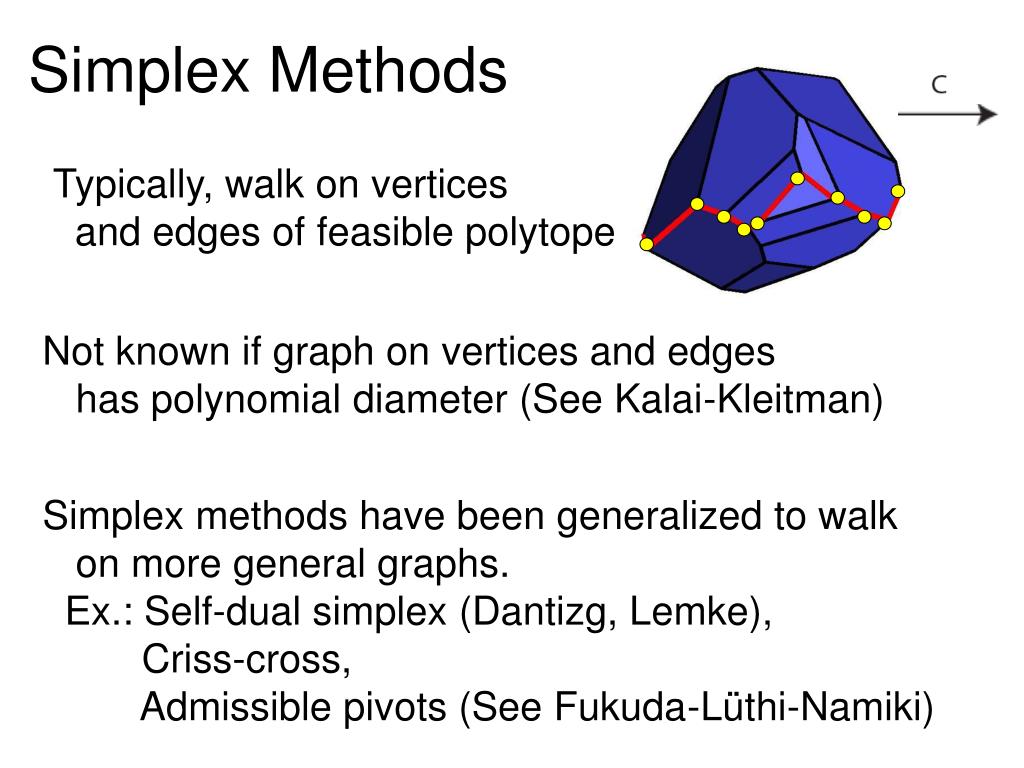
In early 1980s karmarkar (1984) published a paper introducing interior point methods to solve linear-programming problems. a simple way to look at differences between simplex method and interior point method is that a simplex method moves along the edges of a polytope towards a vertex having a lower value of the cost function, whereas an interior point method begins its iterations inside the polytope and moves towards the lowest cost vertex without regard for edges. The original interior point method for linear programming by karmarkar [kar84], and the second of which underlies the e cient algorithms used for solving large scale linear programs in industry today. In 1982/83 dr. narendra karmarkar was employed as a postdoc at the ibm san jose research laboratory. during that year he invented what became known as karmarkar’s algorithm, which is an interior-point method based on projective transformations of polytopes. What we accomplished: karmarkar’s algorithm is an interior-point algorithm for solving linear programming (lp) problems in polynomial time. it was the first polynomial-time algorithm for lp that was claimed to be very practical (whereas the previously-known ellipsoid method was not practical at all).
0 Response to "Interior Karmarkar Point Method"
Posting Komentar